
Loki deployment modes
Loki is a distributed system consisting of many microservices. It also has a unique build model where all of those microservices exist within the same binary.
You can configure the behavior of the single binary with the -target command-line flag to specify which microservices will run on startup. You can further configure each of the components in the loki.yaml file.
Because Loki decouples the data it stores from the software which ingests and queries it, you can easily redeploy a cluster under a different mode as your needs change, with minimal or no configuration changes.
Comparison of deployment modes
Monolithic mode
Also known as single binary deployment.
The simplest mode of operation is the monolithic deployment mode. You enable monolithic mode by setting the -target=all command line parameter. This mode runs all of Loki’s microservice components inside a single process as a single binary or Docker image.
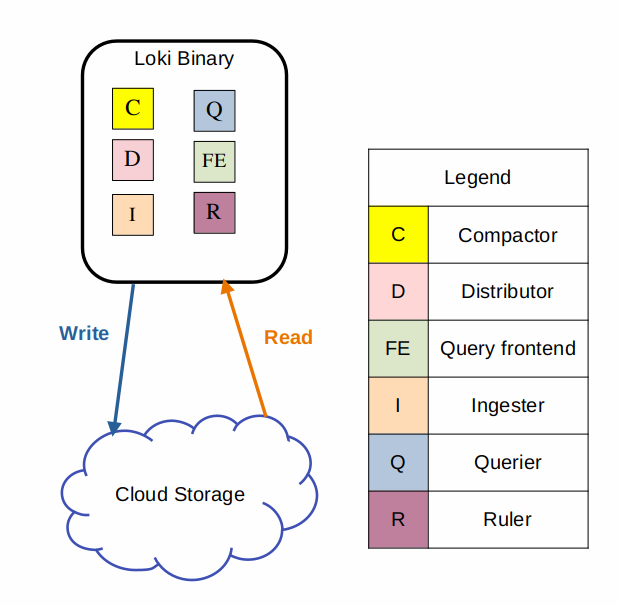
Monolithic mode is useful for getting started quickly to experiment with Loki, as well as for small read/write volumes of up to approximately 20GB per day.
Query parallelization is limited by the number of instances and the setting max_query_parallelism which is defined in the loki.yaml file.
HA Monolithic mode
Also known as HA single binary deployment. This mode replaces the deprecated Simple Scalable Deployment (SSD), which will be removed in Loki 4.0.
HA monolithic mode sits between monolithic mode and microservices mode: it provides high availability and moderate horizontal scalability without the operational complexity of managing individual microservices. If you need fine-grained, per-component scaling, use microservices mode instead.
You can horizontally scale a monolithic mode deployment to more instances by using a shared object store, and by configuring the
ring section of the loki.yaml file to share cluster state between all instances.
Configuration requirements
The following requirements must be met to run Loki in HA monolithic mode:
Run every instance with
-target=all. All replicas use the single-binary target so that every process serves every component.Shared object storage. All instances must read from and write to the same S3-compatible bucket (or equivalent) for chunk data and, if rulers are used, a separate bucket for ruler data. Local disk is only used for ephemeral caches and the write-ahead log (WAL).
Memberlist for ring state. Configure the
memberlistblock so that every instance knows the addresses of all other instances. Setcommon.ring.kvstore.store: memberlistso that all internal rings (ingester, distributor, and so on) use the shared memberlist cluster.Replication factor of 3. Set
common.replication_factor: 3and run at least three instances so that the cluster can tolerate the loss of one instance without data loss.Dedicated compactor instance. Designate one instance as the main compactor by setting
compactor.horizontal_scaling_mode: mainon one instance andworkeron all others. The address of the main compactor needs to be set incommon.compactor_grpc_address.Load balancer in front of all instances. Route all inbound push and query traffic to every replica in round-robin order.
See the HA single binary example for a more complete config.
Microservices mode
Also known as distributed deployment.
The microservices deployment mode runs components of Loki as distinct processes. The microservices deployment is also referred to as a Distributed deployment. Each process is invoked specifying its target.
For release 3.3 the components are:
- Bloom Builder (experimental)
- Bloom Gateway (experimental)
- Bloom Planner (experimental)
- Compactor
- Distributor
- Index Gateway
- Ingester
- Overrides Exporter
- Querier
- Query Frontend
- Query Scheduler
- Ruler
- Table Manager (deprecated)
Tip
You can see the complete list of targets for your version of Loki by running Loki with the flag
-list-targets, for example:docker run docker.io/grafana/loki:3.2.1 -config.file=/etc/loki/local-config.yaml -list-targets
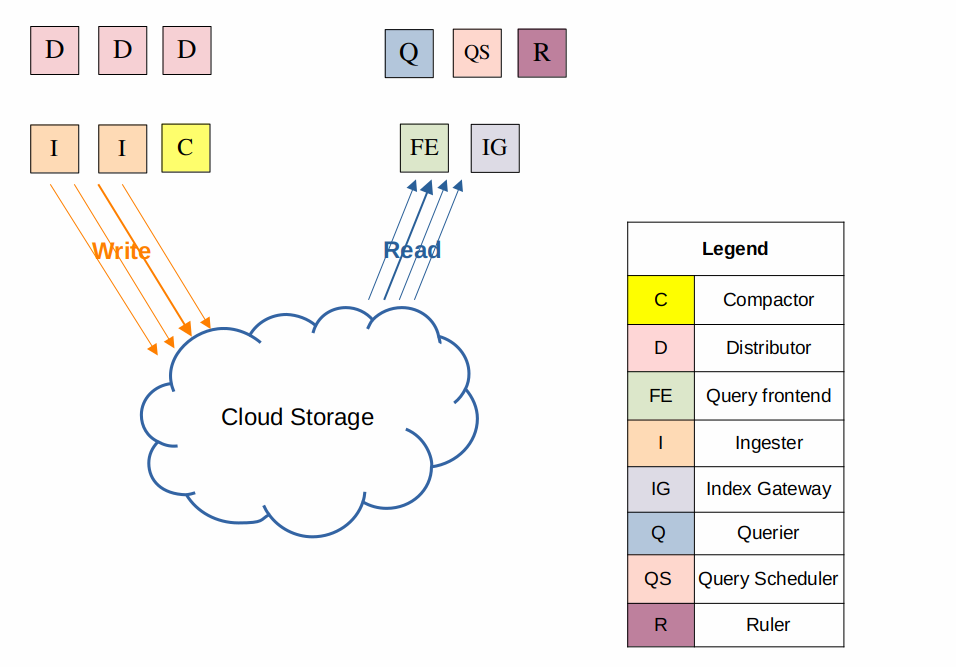
Running components as individual microservices provides more granularity, letting you scale each component as individual microservices, to better match your specific use case.
Microservices mode deployments can be more efficient Loki installations. However, they are also the most complex to set up and maintain.
Microservices mode is only recommended for very large Loki clusters or for operators who need more precise control over scaling and cluster operations.
Microservices mode is designed for Kubernetes deployments. A community-supported Helm chart is available for deploying Loki in microservices mode.